APPLIED DIGITAL LEARNING JOURNEY&BLOG
Innovate, Teach, Iterate
Creating Significant Learning Environments

I
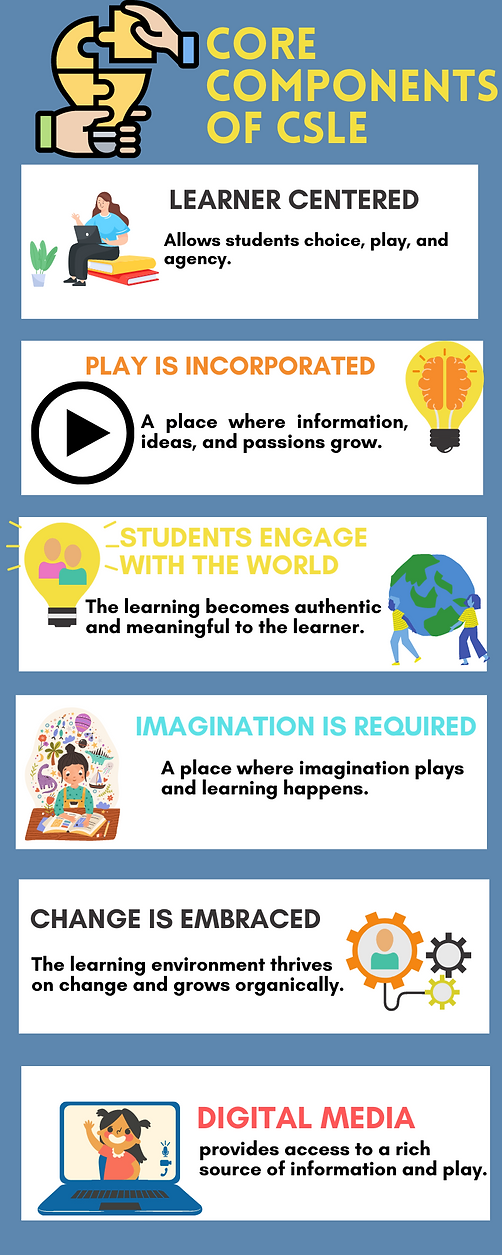
One of my favorite projects to facilitate in my classroom is based on a science learning standard that allows students some choice and play. The student is expected to design a descriptive investigation of force on an object such as a push or a pull, gravity, friction, or magnetism. I provide all types of materials, but students get to choose. We watch some Rube Goldberg videos to get us motivated, but then it is up to them to use their imaginations to design the investigation. Watch students play and watch them become enthralled with learning. In a New Culture of Learning the last sentence of the book is perhaps the most powerful. And where imaginations play, learning happens (Brown & Thomas 2011). To create significant learning environments that align with a new culture of learning imagination is required.
Creating a Significant Learning Environment
with a New Culture of Learning
To create a significant learning environment within a new culture of learning, the culture needs to focus on learning through engagement within the world. It should thrive on change and grow organically. It should shift from a teaching-based approach to a learner-based approach. In the new culture of learning, the classroom as a model is replaced by learning environments in which digital media provides access to a rich source of information and play, and the processes that occur within those environments are integral to the results (Brown & Thomas 2011).
In this fluid and ever changing world, education has not kept up with the pace. It seems to be stuck in the mechanistic approach where standards are to be mastered by every student at the same time. In the current culture, the teaching-based approach is favored more often than the learner- based approach. The current culture isn’t about the learner, it’s about results. This learning environment is not uncovering learners’ talents and is leaving them with more to be desired from their educational experience. It is lacking the key components of COVA, choice, ownership, voice, and authentic learning environments.
By incorporating project based learning in classrooms we can achieve a more learner-based approach that fits the new culture of learning. In the new culture of learning, the point is to embrace what we don’t know, come up with better questions about it, and continue asking questions in order to learn more and more, both incrementally, and exponentially (Brown & Thomas, 2011). Through projects that have a driving question and a problem to solve, students can see learning through a different lens than regurgitating information. Learners can become comfortable with not knowing, asking questions and then asking more questions on the quest to learn and solve authentic problems. It is through this process that students gain more agency and begin to have fun learning. Research has proven that children make sense of their world through playing. Children use play and imagination as the primary mechanisms for making sense of their new, rapidly evolving world. In other words, as children encounter new places, people, things, and ideas, they use play to cope with the massive influx of information they receive (Brown & Thomas, 2011). It is the best feeling to be in a room full of children who are having fun learning.
.png)
For the past six years I have been incorporating project based learning into my classroom. Learners love it. During the pandemic and post pandemic I have incorporated more blended learning into the classroom. It is through these two models combined that I hope to create a significant learning environment with the learning as the central focus.. My innovation plan, Project Based Learning, Meet Blended Learning, will infuse more play, imagination, and inquiry into the learning environment. The goal is for the plan to grow organically and change with the times. It is through the blended learning that learners will be offered more personalization and customization in their learning.
One of the main challenges I have found when planning projects for PBL is that it can be time consuming and often requires more time to plan than the time allotted in traditional professional learning community time each day. Another challenge for teachers is to manage and incorporate multiple learning standards within the project and to include formal and informal assessments during the duration of the project. Creating a space for students to have agency and choice takes mindfulness. It also takes getting to know your students and placing them at the center. Although personalization is the goal with learning, there can be constraints with time and offering students complete freedom. Time management to create learner-centered classrooms is one of the biggest hurdles. Getting all teachers to buy in to project based learning can be tough because there is a learning curve at first to do it right. At first, projects might not go as well as planned and it might be uncomfortable to give up so much control to the learners. In the end, any challenges will be worth working through to create significant learning environments.
Embracing change and seeing information as a resource can help us stop thinking of learning as an isolated process of information absorption and start thinking of it as a cultural and social process of engaging with the constantly changing world around us (Brown & Thomas, 2011). It is my hope that the stakeholders in my organization will embrace change with my innovation plan after seeing the success I am having in my classroom creating a significant learning environment where information, ideas, and passions grow. An environment where students are heard, have choices, and take ownership of their learning should be the standard for all learning environments.
References
Bates, T. [ChangSchool]. (2015, December 14). Dr. Tony Bates on building effective learning
environments [Video file]. Retrieved from https://www.youtube.com/watch?v=3xD_sLNGurA&feature=youtu.be
Harapnuik, D. (2015, May 8). Creating significant learning environments (CSLE) [Video file]. Retrieved
from https://www.youtube.com/watch?v=eZ-c7rz7eT4
Thomas, D. [TEDx Talks]. (2012, September 12). A new culture of learning, Douglas Thomas at TEDxUFM
[Video file]. Retrieved from https://www.youtube.com/watch?v=lM80GXlyX0U&feature=youtu.be
Thomas, D., & Brown, J. S. (2011). A new culture of learning: Cultivating the imagination for a world of constant change. Lexington, KY: CreateSpace.